
Privacy-friendly analytics
Cookieless Web Analytics For Privacy-First Websites
Understand your website traffic without cookies, consent banners, localStorage, fingerprinting, or visitor profiles. Statable is a cookieless analytics platform: easy to set up, simple to migrate to from Google Analytics, and built for GDPR, ePrivacy, CCPA, and PECR.
No card required • 30 days trial • Based in Europe
 United States
 Germany
 Brazil
 Belgium
 Canada
 Ukraine
 Netherlands
 Poland
 France
 Spain
Spain Chrome
 Firefox
 Safari
 Mobile Safari
 Edge
Edge Opera
Opera Brave
Brave Samsung Internet
 Yandex Browser
 DuckDuckGo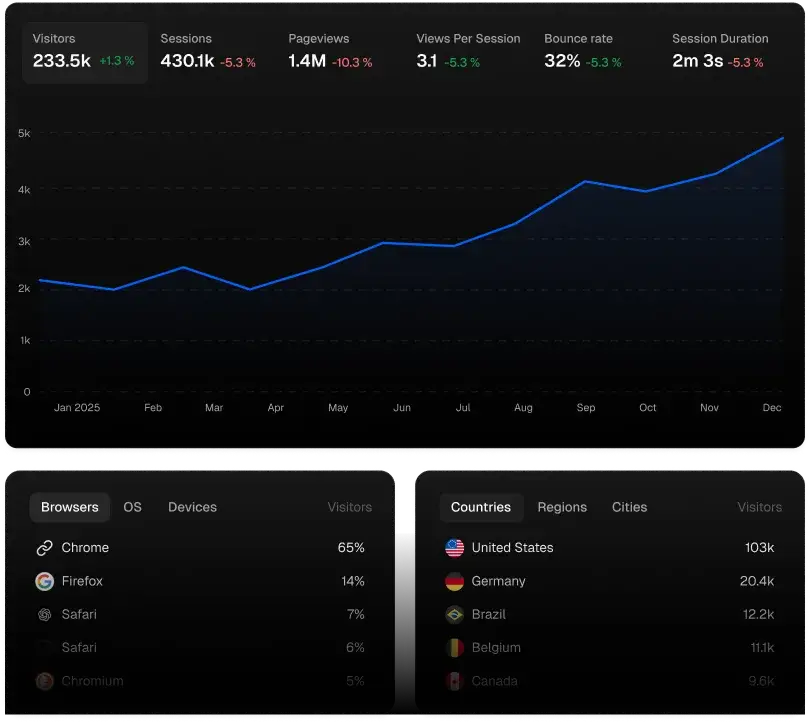
0 Cookies
No cookies, no localStorage, no fingerprinting. Nothing is written to the visitor's device.
30 Sec Setup
Install one lightweight script and watch live visitors arrive in real time.
No Cookie Banner
No cookie consent banner required for Statable analytics in most cases.
Privacy First
Why Cookie Tracking Became A Problem
For years, cookies were the default way to measure website traffic. They helped analytics tools recognize returning visitors, connect sessions, and build detailed reports. But the web has changed.
Today, cookie-based analytics creates problems for both website owners and visitors. In most scenarios, cookies require consent. That means cookie banners, consent management tools, and extra configuration before you can collect useful analytics. For visitors, this creates friction. For website owners, it adds complexity and legal exposure.
Consent banners also affect the quality of your data. Some visitors accept tracking. Others reject it. Some never make a choice. As a result, your analytics can become incomplete before the visitor even starts using your website.
Browser restrictions, ad blockers, and privacy extensions make the picture even more complicated. A 2024 Ghostery and Censuswide survey found that 52% of Americans use an ad blocker, with privacy protection cited as the top reason.
Cookie-based analytics can leave site owners with the worst of both worlds: a more complicated setup and a less complete view of what is happening on their website.

Privacy First
What Cookieless Analytics Means
Cookieless analytics means measuring website traffic without storing cookies in the visitor's browser or creating persistent identifiers to recognize users over time.
With Statable, there are no cookies, no localStorage, no cross-site tracking, no personal profiles, and no invasive identifiers. Traffic is measured in a privacy-friendly way, helping website owners understand what is happening while keeping individual visitors private.
This does not mean losing reports that matter. You can still see visits, pageviews, top pages, traffic sources, countries, devices, browsers, and events. The difference is that the data is collected without turning visitors into profiles or following them across the web.
How we work
How Statable Does Cookieless Tracking
Statable is privacy-first by architecture. It uses a lightweight script and a short-lived server-side identity model designed to measure visits inside a limited time window, not to track people across websites or over long periods of time.
Step 1
On The Page
A small script sends one request per pageview. When someone opens your page, Statable's tracking script sends a single request: the page URL, the referrer, and your site id. Nothing else.
That is enough to build useful traffic reports without writing anything to the visitor's device. The script does not read document.cookie, does not write to localStorage, and does not use canvas, audio, font, or device fingerprinting techniques. Browser, OS and device family are worked out on our side from the User-Agent header that every browser already sends with every request.
Step 2
On The Server
Statable turns each visit into a single number using a keyed hash. The inputs are your site's id, the visitor's IP, their User-Agent and the current date. The key is a secret that never leaves our servers. The raw IP is discarded once the hash is computed and is never written to storage. The User-Agent is reduced to browser, OS and device family on the same path, and the full string is not kept in your analytics data.
Because the date is one of the inputs, the number changes every day. Because your site id is one of them, the same person on two different sites produces two unrelated numbers. And because the key is secret, someone who knows a visitor's IP and browser still cannot work out which number they produced, so the value cannot be checked against a guess.
Step 3
No Cross-Day Identity
Statable is designed not to recognize the same person across multiple days. Because the date changes at midnight on our servers, the number for the same visitor on Tuesday is mathematically unrelated to the number on Wednesday. We cannot tell you that the person who read your post on Tuesday came back on Friday. A visit that starts before midnight and continues after it keeps the previous day's number for up to half an hour, so a single session is not split in two.
For most content websites, marketing pages, SaaS websites, and small businesses, this is a good trade-off. You still get the reports that matter: visits, pageviews, sources, campaigns, countries, devices, browsers, events, and goals. What you avoid is long-term identity tracking.
Measure Everything
Actions, Not Identities
Statable also respects Global Privacy Control signals and supports event tracking without invasive profiling. You can measure actions such as signups, downloads, button clicks, form submissions, and goals while keeping analytics privacy-friendly by design.
Downloads
Signups
Button Clicks
Form Submissions
Designed To Avoid The Cookie Banner
Cookie banners are not just a design problem. They interrupt the visitor journey at the exact moment when someone is trying to make a purchase, sign up, submit a form, or book a demo.
Because Statable is a cookieless tracking solution — no cookies, no localStorage, no invasive identifiers — visitors can use your website without being interrupted by cookie consent popups for analytics. Fewer interruptions mean a cleaner journey to signups, purchases, and form submissions.
Statable also reduces operational overhead. You spend less time configuring consent management tools, debugging consent modes, and maintaining complex tracking setups.
More Reliable Data Without Consent Gaps
When analytics depends on cookies, rejected consent creates blind spots. Ad blockers, privacy extensions, and browser restrictions can make those gaps even larger.
Google Analytics and other platforms may try to fill missing data with machine learning, modeled reports, or sampling.
Statable takes a different approach
- Reports real visitor activity, not AI estimations or sampled data.
- Built-in bot filtering helps reduce artificial noise, giving you a clearer and more transparent view of website traffic.
Compliance And Legal Risk
The privacy landscape has become stricter over time. The ePrivacy Directive introduced rules for privacy in electronic communications in 2002. PECR brought those rules into UK law in 2003. GDPR has applied across the EU since 2018, and CCPA became effective in California in 2020.
For website owners, the direction is clear: personal data, consent, tracking technologies, and data transfers are under increasing scrutiny.
Recent European regulatory decisions have shown that using traditional analytics tools can create compliance challenges, especially around personal data transfers, safeguards, and consent.
Statable is designed for GDPR-ready analytics, with CCPA, ePrivacy and PECR in mind. It does not store cookies, does not use localStorage, and does not create long-term profiles of individual visitors.
The Hidden Cost Of Cookie Banners
Cookie banners cost more than they appear to.
They add friction for visitors, create extra work for website owners, and can make analytics harder to trust when consent is rejected or ignored. They also introduce ongoing maintenance: consent tools, regional rules, consent modes, tracking configuration, and periodic reviews.
A cookieless setup reduces these moving parts. Your website stays cleaner, your analytics setup becomes simpler, and visitors are not interrupted before they can understand what you offer.
What You Still Get Without Cookies
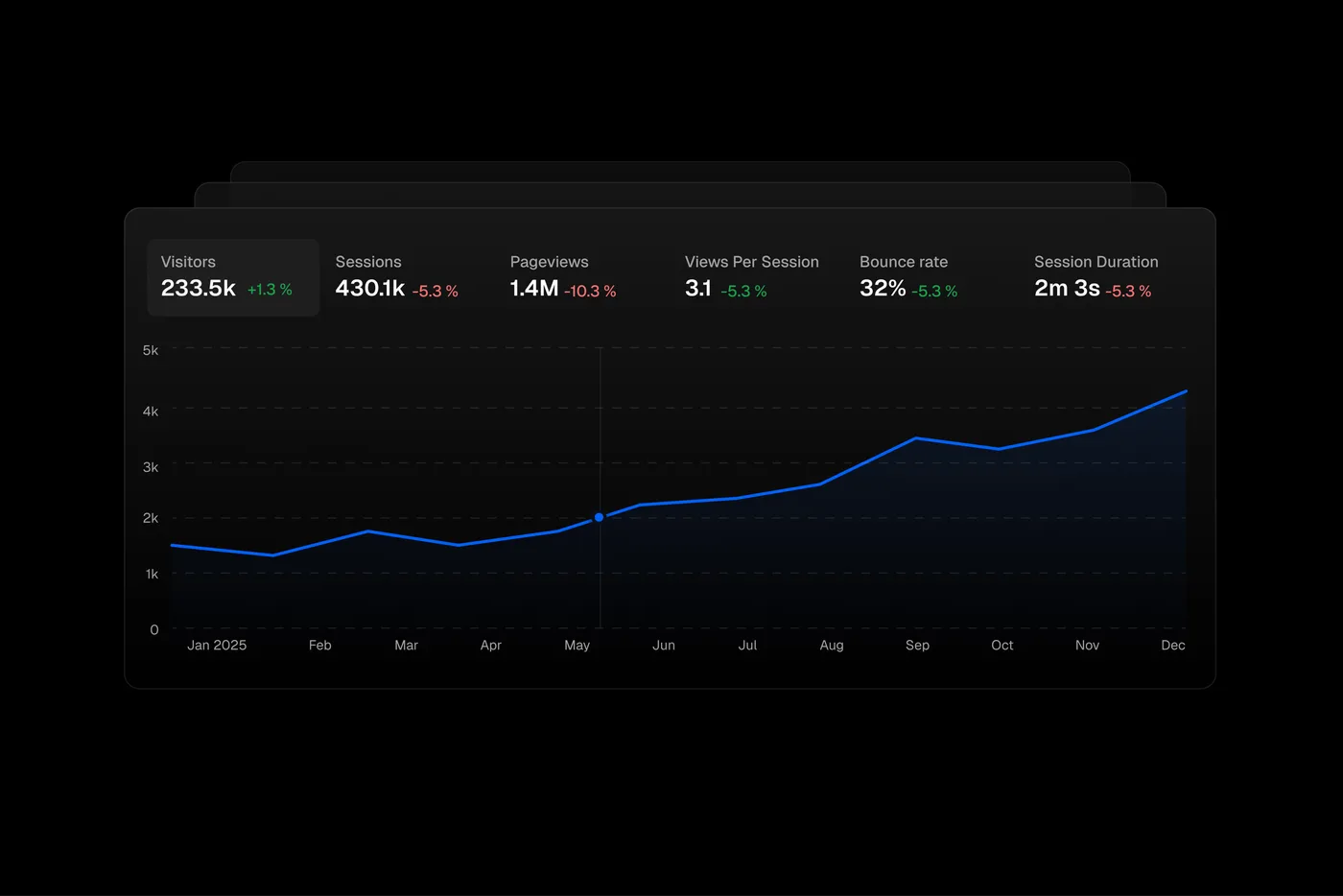
Cookieless analytics does not mean losing the reports that help you run your online business.
Statable gives you the key metrics website owners actually need
- Visitors
- Sessions
- Pageviews
- Bounce rate
- Session duration
- Traffic sources
- Channels
- UTM campaigns
- Top pages
- Entry pages
- Exit pages
- Geography
- Devices
- Browsers
- Operating systems
- Custom events
- Goals
You can still see where visitors come from, which pages attract attention, where people leave, what devices they use, and which actions they take. All of this is simple web analytics in one clean, real-time dashboard.
Easy Migration From Google Analytics
You do not have to switch blindly.
Import your Google Analytics history into Statable, compare both platforms side by side, and evaluate the difference using your own website data. You can check traffic, sources, pages, devices, countries, and events before deciding whether to move away from GA4.
Start with a 30-day trial, no credit card required.
Who Cookieless Tracking Is Best For
Cookieless tracking is a strong fit for website owners who need clear traffic reports without following people around.
Statable is especially useful for creators, indie hackers, SaaS companies, publishers, agencies, small businesses, and privacy-conscious brands. It is also a good fit for European websites and teams that want to reduce unnecessary legal exposure while still understanding how people use their website.
If your main questions are about traffic, sources, pages, geography, devices, campaigns, and key user actions, tracking without cookies gives you the insights you need.
When GA May Still Be A Better Fit
Statable is not the right tool for every analytics use case.
Google Analytics may be a better fit if your business is deeply tied to Google Ads, depends on advanced enterprise reporting workflows, or needs mobile app analytics through Firebase. GA4 can also make sense for teams with dedicated analysts or data engineers who are comfortable building complex reports and working inside the broader Google ecosystem.
For most websites, creators, and businesses, Statable is a simpler, cleaner, more privacy-friendly Google Analytics alternative.
FAQ